Search for the best accounting software for small businesses, and most of the results are written for businesses operating in completely different conditions.
The recommendations often assume card payments, stable internet, predictable tax systems, and business owners who already have access to professional accounting support. However, that is not how most Nigerian small businesses operate.
In Lagos, a business may receive payments through bank transfers, POS, and cash in the same day. While in Abuja, one may be managing sales, inventory, expenses, and staff from a phone. And somewhere in Port Harcourt, a business may need to keep working through network or power interruptions.
So what makes accounting software a good fit for a Nigerian small business?
It needs to work with the way local businesses actually receive payments, manage their finances, and operate day to day. It should be simple enough for a business owner who is not an accountant but capable enough to grow with the business.
Here are the main options and what each one is best suited for.
What to Look for in Accounting Software for a Nigerian Small Business
Before comparing specific platforms, it helps to know what you are actually comparing.
The right software should make it easier to:
Manage Naira transactions and local payment methods
Track sales, expenses, and business income in one place
Manage inventory if you sell physical products
Give business owners useful financial information without requiring an accounting background
Manage staff and permissions as the business grows
Support multiple branches when the business expands
The best option will depend on the type and stage of your business. A freelancer working with international clients may need something different from a retailer with two physical locations.
With that in mind, here is how the main options compare.
Best Overall: BrandDrive
For most Nigerian small businesses, BrandDrive is the strongest all-round option because it brings the main parts of running a business into one system.
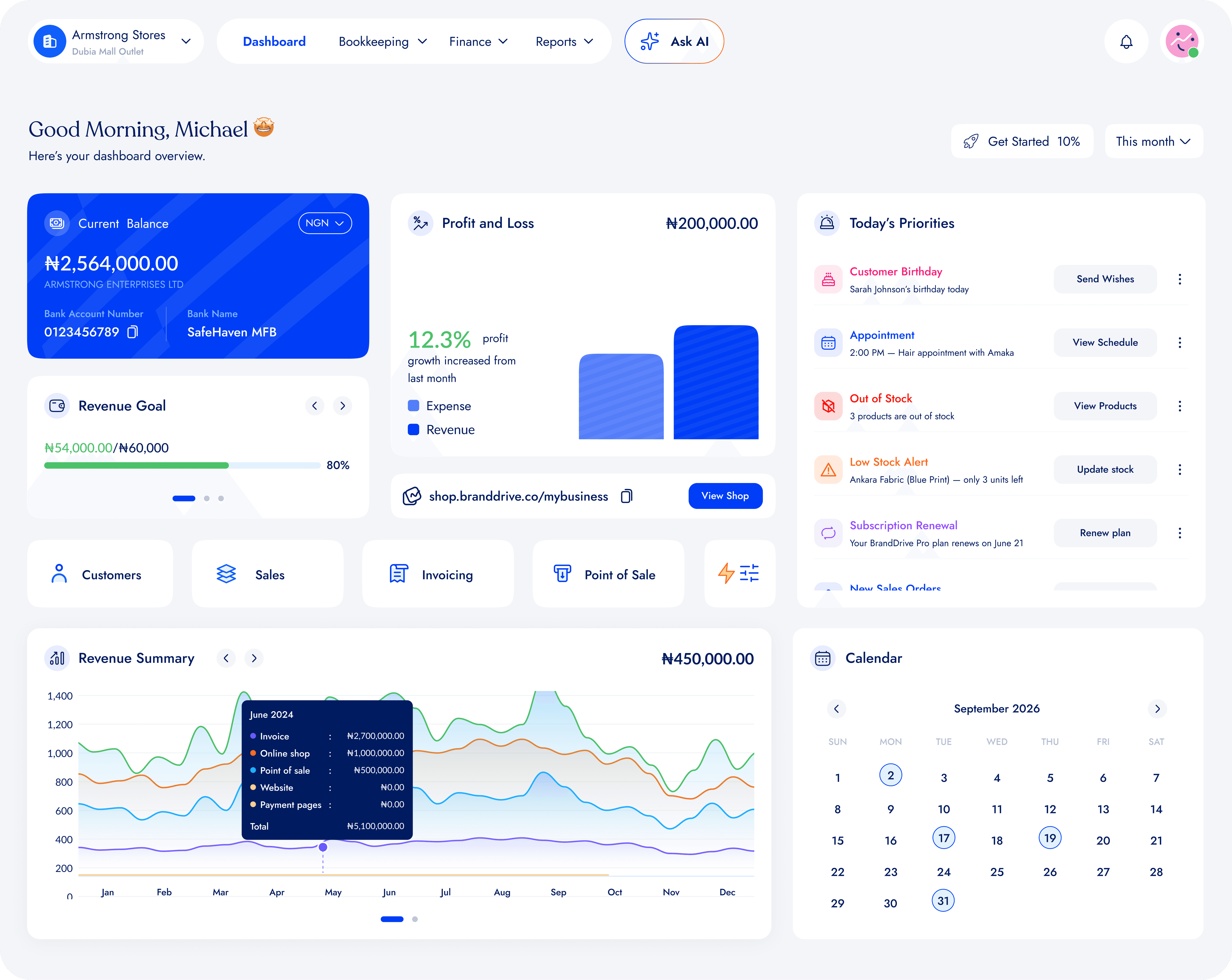
You can manage sales, invoices, expenses, inventory, payments, bookkeeping, and other core business operations without having to move between several different tools.
This is important because the problem with using separate apps is not always the cost of each individual tool. It is the work involved in keeping them all updated and making sure the information in one system matches the information in another.
A sale recorded in one place should not require you to update your inventory somewhere else manually. A payment should not have to be recorded again before your financial records are accurate. Your business information should be up to date at every point in time.
You get to do all of these with BrandDrive, and it also gives business owners access to analytics and Nivram, its AI business analyst, which helps turn business data into useful insights.
Instead of simply showing you a collection of numbers, it can help you understand what is happening across your sales, expenses, and overall business performance.
For a small business that wants to manage more of its operations from one place, this makes BrandDrive a strong fit.
It works particularly well for businesses that:
Sell physical products and need inventory management
accept payments through multiple channels
Need invoicing, sales, and expense tracking in one system
Have employees or are growing their team
Operate more than one branch or plan to expand
Want business insights without having to manually analyze spreadsheets
The main advantage is the connection between these different parts of the business. Your sales, inventory, payments, and financial records do not have to exist as separate pieces of information.
That makes it easier to see what is happening in the business and make decisions based on the numbers in front of you.
Best for: Nigerian small businesses that want an all-in-one system for managing their operations and finances.
Pricing: BrandDrive has a free plan for businesses getting started, with paid plans available as the business grows.
Best for International Clients: QuickBooks or Wave
If you work with international clients, already have an accountant who uses global accounting software, or need financial reports that foreign partners are familiar with, QuickBooks and Wave may be a better fit.
QuickBooks offers more advanced accounting and reporting features, making it useful for businesses with more complex financial needs.
Wave is a simpler option for small businesses that want basic accounting and invoicing tools without paying for a more advanced system.
The trade-off for Nigerian businesses is that local payment methods and workflows may require more manual work. If your business receives payments through bank transfers, POS, and other local channels, you may need to spend more time keeping your records updated.
Best for: Businesses with international clients, international reporting needs, or accountants already familiar with global accounting platforms.
Best for Social Commerce Sellers: Bumpa
For businesses that receive most of their orders through Instagram, WhatsApp, and other social channels, Bumpa is a strong option to consider.
Its focus on sales, orders, inventory, and customer management makes it useful for businesses selling products through social commerce.
A fashion business taking orders through Instagram DMs, for example, may find it useful for keeping track of products and sales as the business grows.
The limitation is scope. If your business needs more extensive accounting, payroll, financial management, or broader business operations in one place, you may eventually need additional tools.
Best for: Product-based businesses that sell mainly through social media and need better control over orders and inventory.
How Business Size and Stage Should Drive Your Choice
The best accounting software for a business depends on what the business needs to manage right now.
If You Are Just Starting Out
A simple, affordable system may be all you need.
At this stage, focus on recording sales, tracking expenses, sending invoices, and understanding where your money is going. You may not need every advanced feature available.
The important thing is to start building proper financial records early, rather than waiting until the business becomes difficult to manage.
If You Have Staff and Regular Inventory
Your needs change once other people are involved in the business.
You may need staff permissions, inventory management, expense tracking, and sales records that work together. A system that only handles basic bookkeeping may leave you relying on other tools for everything else.
This is where an all-in-one platform can become more useful.
If You Operate Multiple Branches
Once your business has more than one location, visibility becomes important.
You need to know how each branch is performing without manually collecting information from different locations. Multi-branch management allows you to see your operations from one place and compare performance across locations.
If You Work With International Clients
Currency support and reporting may become more important.
If you regularly invoice clients outside Nigeria or work with international partners, choose software that can handle the currencies and financial reports your business actually uses.
The right choice is the one that fits the way your business operates. Choosing only because a tool is cheap or popular can mean switching systems again when your business outgrows it.
Questions to Ask Before Choosing Accounting Software
Before committing to any accounting software, ask:
Does it support the payment methods my customers actually use?
Can I track sales, expenses, and income without relying on several separate tools?
If I sell physical products, does it include inventory management?
Can my team use it with the right permissions?
Will it support more branches, staff, and products as my business grows?
Can I easily understand how my business is performing?
Can I get help when I run into a problem?
The answers will tell you more than a long list of features.
Conclusion
There is no single accounting software that is perfect for every Nigerian business.
A freelancer working with international clients may have different needs from a retailer managing inventory and staff. A small trader may only need simple records today, while a growing business may need sales, payments, inventory, expenses, and accounting connected in one system.
For most Nigerian small businesses that want to manage more of their operations in one place, BrandDrive offers a strong all-in-one option. You can start with the tools your business needs today and add more as the business grows.
See how BrandDrive fits your business. Start for free and manage your sales, invoices, expenses, inventory, payments, and more from one platform.