
Freelancing gives you something many traditional jobs do not. Control over your time, over the kind of clients you work with, and, if things go well, control over how much you earn.
The challenge is that your income rarely arrives in the same way every month. One client pays today, another pays two weeks late, and someone else asks for an extension.
Meanwhile, your internet subscription is due, your design software renews automatically, and rent is not waiting for your invoice to be paid.
That is why managing money as a freelancer is different from managing money on a salary. It is less about knowing how much you earned and more about knowing how much you actually kept, what you spent to earn it, and whether your freelance career is becoming more profitable over time.
The right expense management tool helps you answer those questions without spending hours updating spreadsheets. In this guide, we'll look at some of the best expense management tools for freelancers in Nigeria and how to choose the right one for your stage of business.
Why Expense Tracking Matters More When You Freelance
When you're employed, someone else usually handles payroll, tax deductions, and salary records. As a freelancer, all of that becomes your responsibility. If you don't keep proper records, simple questions become difficult to answer.
How much did you actually earn this month?
Which client paid you?
How much did you spend on software and subscriptions?
Which expenses were personal and which were business-related?
Are you making more money than six months ago?
For many freelancers, they struggle majorly because business money and personal money quickly become mixed together, not necessarily because they spend recklessly.
They struggle because a payment from a client lands in the same account they use for groceries, transport, and airtime, and after a few months, everything starts looking the same.
When that happens, it's difficult to know if your freelance business is actually growing or if money is simply moving in and out of your account.
What to Look for in an Expense Management Tool
Not every expense tracker is designed for freelancers. Here are the features that matter most.
Easy expense tracking
Recording expenses should take seconds, not minutes. If logging every purchase feels like work, you'll eventually stop doing it.
Business and personal expense categories
A good tool should make it easy to separate work expenses from personal spending, even if you're using one account.
That becomes especially useful when the time for filing taxes comes or when reviewing your monthly income.
Income and invoice tracking
Freelancing isn't only about tracking what goes out. You also need to know who has paid you, who still owes you money, and which invoices are overdue.
Reports you can actually understand
You shouldn't need an accounting background to understand your finances. Good software should show where your money is going in simple, easy-to-read reports.
Pricing that makes sense
Many freelancers are still growing their business. Paying hundreds of dollars every month for software usually doesn't make financial sense. Choose something that fits your current stage.
Best Expense Management Tools for Freelancers in Nigeria
1. BrandDrive
Price: Free plan available | Premium plans start from ₦15,000/month
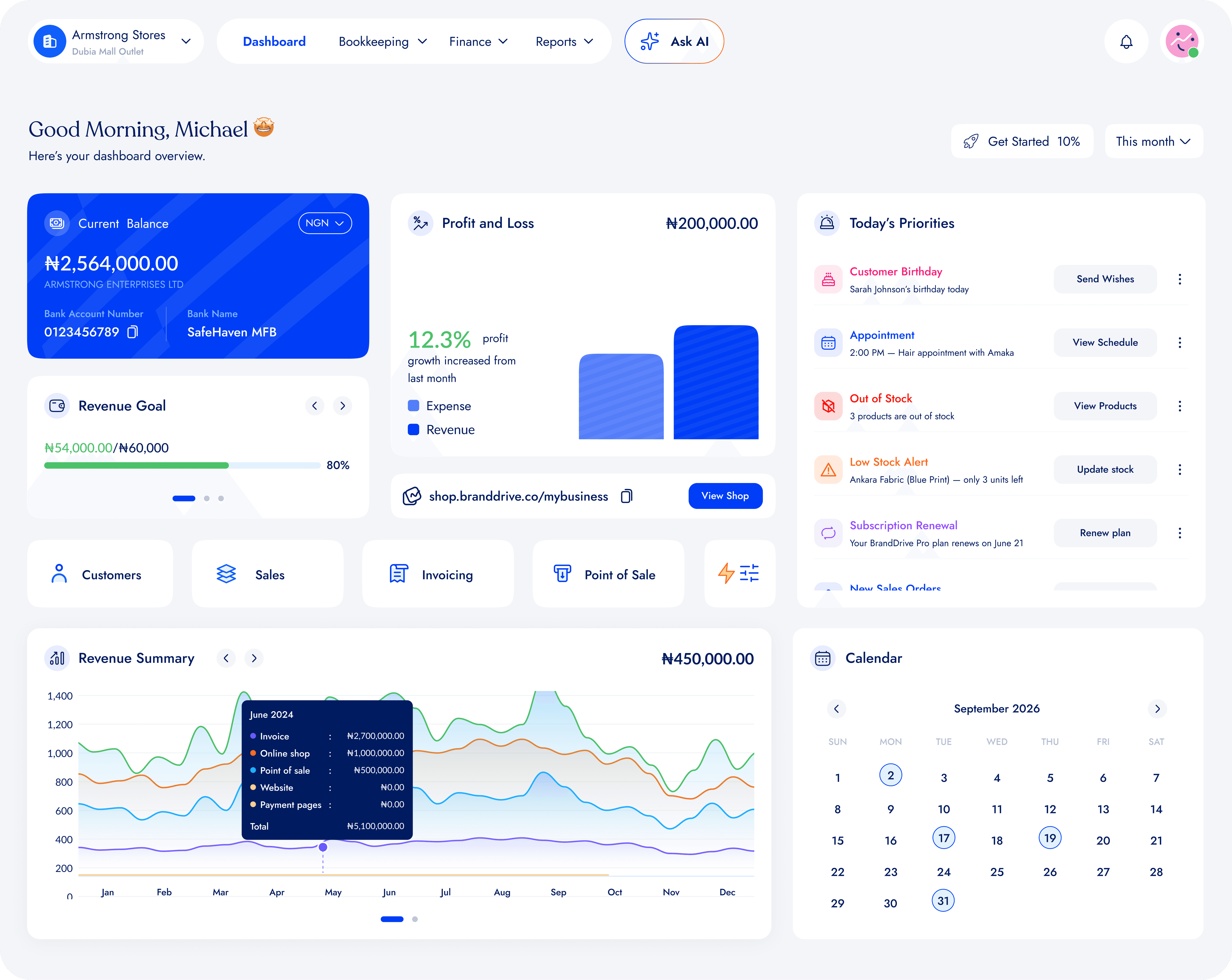
One thing that makes BrandDrive stand out for freelancers is that you can start without paying anything. It comes with a forever-free plan that gives you access to most of the features you'll need to manage your finances, with usage limits that grow alongside your business. That means you can organize your income, track your expenses, send invoices, and build better financial habits before committing to a paid plan.
As your freelance career grows, you can move to BrandDrive Business without switching to a different platform. Invoicing, expense tracking, financial reports, customer management, and other business tools all work together, so you are not switching multiple apps just to understand how your business is performing.
Because BrandDrive was built for African businesses, it also reflects how freelancers here actually work. The pricing is local, the workflows are familiar, and you are not paying for enterprise features you'll probably never use.
If you're looking for an expense management tool that can grow with your freelance business without forcing you to pay from day one, BrandDrive is one of the strongest options available.
2. Wave
Price: Free
Wave is popular among freelancers because it offers basic bookkeeping and expense tracking without a monthly subscription.
It works well if you're just getting started and want to organize your finances without spending extra money.
Its biggest limitation is that it was designed primarily for North American businesses. Payment options and workflows are not always ideal for freelancers working across African markets, and many users eventually outgrow the free feature set.
3. Zoho Books
Price: Starts from $20 monthly
Zoho Books combines invoicing, expense tracking, and financial reporting in one platform.
It works particularly well for freelancers with international clients because it supports multiple currencies and integrates with other Zoho products.
The downside is that it can feel more advanced than many freelancers actually need. If your goal is simply to track income and expenses, the setup process may feel heavier than necessary.
4. QuickBooks
Price: Starts from $35 monthly
QuickBooks is one of the best-known accounting platforms in the world.
It offers detailed reporting, expense tracking, invoicing, and bank reconciliation, making it suitable for freelancers who are building larger businesses or managing high client volumes.
For many African freelancers, however, the pricing and complexity can be difficult to justify during the early stages of growth.
How to Choose the Right Tool
The best software is not necessarily the one with the longest feature list.
It is the one you'll actually use every week.
If you're just starting out, a simple expense tracker may be enough.
As your client list grows, you'll probably want invoicing, reporting, and better visibility into your business finances.
The important thing is to build good financial habits early.
Once you know where your money is coming from and where it's going, making better business decisions becomes much easier.
If you also want to understand why more freelancers are moving away from notebooks and spreadsheets, read our guide on Why Digital Expense Tracking Beats Manual Record Keeping.
And if you're trying to separate your work expenses from your personal spending, our guide on How to Track Personal and Business Expenses Effectively walks you through the process.