Starting a startup is exciting because every new customer feels like proof that your idea is working.
But behind every sale is another reality founders quickly discover. Software subscriptions need to be renewed, suppliers need to be paid, team expenses begin to increase, marketing costs grow, and before long, money starts leaving the business from several different directions.
At first, it feels manageable because there aren't many transactions. A bank app and a spreadsheet seem like enough.
Then the business grows. Expenses increase, new tools get added, reimbursements become more frequent, and one day you realize you know how much money is left in your account but not exactly where it all went.
That is usually when founders start looking for expense management software.
The right tool does far more than record expenses. It helps you understand how your business is spending money, where costs are increasing, and whether your current pace is sustainable.
In this guide, we'll look at some of the best expense management software for startups in Africa, including global platforms and tools built specifically for African businesses.
The Best Expense Management Software for Startups in Africa
BrandDrive
Zoho Books
QuickBooks
Wave
BrandDrive
Price: Starts from N15,000
For many founders, the goal is not simply to record expenses. It is to understand what those expenses mean for the business.
BrandDrive was built with that in mind.
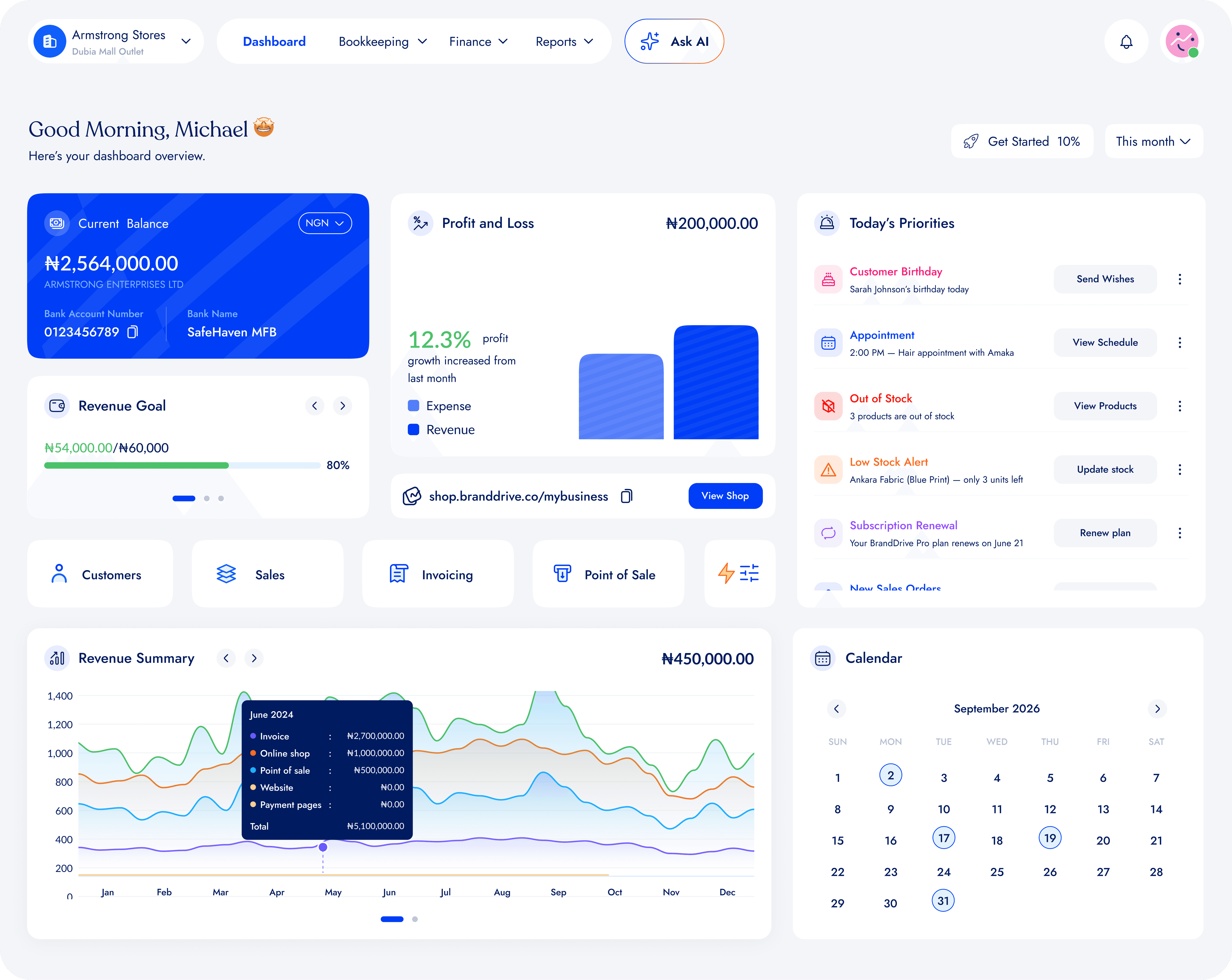
Instead of treating expense tracking as a separate activity, BrandDrive connects it to the rest of your business. Sales, expenses, inventory, invoicing, and reporting all work together, so you are not switching between multiple applications just to understand how the business is performing.
One feature startups will appreciate is Digital Fund Requests. Team members can submit reimbursement requests directly through the platform, attach supporting documents, and send them for approval. Every request is documented, making it much easier to keep spending organised from the beginning.
You can also create approval workflows, ensuring expenses are reviewed before money leaves the business. As your startup grows, this creates accountability without adding unnecessary paperwork.
Because BrandDrive was designed for African businesses, founders also avoid many of the localisation challenges that come with using software built primarily for other markets.
If you are looking for one platform that handles expense management alongside the rest of your operations, BrandDrive is one of the strongest options available today.Zoho Books
Price: Starts from $20 monthly
Zoho Books is one of the most popular accounting platforms for growing businesses. Alongside expense management, it includes invoicing, bank reconciliation, vendor management, and financial reporting.
It also supports multiple currencies, making it useful for startups working with international clients or paying for overseas software subscriptions.
Where Zoho Books works best when your business already uses other Zoho products like Zoho CRM or Zoho Inventory. Everything connects naturally, creating one complete business ecosystem.
The downside is that it can feel overwhelming for founders who simply want a straightforward way to track expenses. There is a learning curve, and many of its features will not be fully used during the early stages of a startup.QuickBooks
Price: Starts from $38 monthly
QuickBooks has been a trusted accounting solution for businesses around the world for many years.
It offers reliable expense tracking, bank reconciliation, budgeting tools, and detailed financial reports. It also integrates with hundreds of third-party applications, making it suitable for startups with increasingly complex financial operations.
For African startups, however, some challenges remain. Local payment workflows are not always as seamless as businesses would like, and certain compliance features were designed around tax systems outside Africa.
QuickBooks remains an excellent platform, but many early-stage founders may find themselves paying for functionality they do not yet need.Wave
Price: Free (with paid add-ons)
For founders trying to keep costs as low as possible, Wave is often one of the first tools they consider.
Its biggest advantage is simple. The core accounting and expense tracking features are free, making it attractive for startups that are still validating their business model.
Wave allows founders to record expenses, create invoices, and generate basic financial reports without paying a monthly subscription.
As the business grows, however, its limitations become more noticeable. Support for African payment systems is limited, collaboration features are basic, and it lacks some of the operational tools growing startups eventually need.
It is a good place to start, but not always the place businesses stay.
What Should You Look for in Expense Management Software?
Choosing expense management software is less about finding the platform with the longest feature list and more about finding one that matches how your startup operates.
Does it give you a complete picture?
Recording expenses is only one part of the job.
The software should help you understand where money is going, which categories are increasing, and how spending is affecting your business over time.
Can your team use it easily?
The best software is the one people actually use.
If submitting expenses, approving requests, or reviewing reports feels complicated, people eventually stop using the system consistently.
Will it grow with your business?
Your needs today will not be your needs a year from now.
Choose software that can support additional team members, more transactions, and more complex workflows without forcing you to migrate to another platform too soon.
Does it fit African businesses?
Many global platforms are excellent products.
But African startups often have different payment methods, pricing expectations, and day-to-day operational realities.
Using software designed with those realities in mind usually makes adoption much easier.
The Best Software Is the One You'll Still Be Using Next Year
Many founders delay setting up proper expense management because the business still feels "small".
Ironically, that is exactly when it is easiest to build good financial habits.
Once transactions begin increasing, trying to organise months of receipts, reimbursements, and subscriptions becomes far more difficult than recording them properly from the beginning.
The right expense management software should quietly become part of how your startup operates. It should help you understand your spending without creating more work for you.
If you are still comparing different options, you may also find our guide on Best Expense Management Software for Small Businesses helpful, where we explain what separates a good expense management system from one that simply records transactions.
And if you are still relying on notebooks or spreadsheets, read Why Digital Expense Tracking Beats Manual Records. Keeping up with understanding why many businesses eventually move to digital tools.